

In this section we will discuss how can mysql DATE_FORMAT be used with java servlet.
MySql DATE_FORMAT Example using Java Servlet
In this section we will discuss how can mysql DATE_FORMAT be used with java servlet.
DATE_FORMAT function of MySql formats the date as it is specified in the argument of its parameter. Syntax of DATE_FORMAT is date_format(date, format). Where date indicates a date and format indicates how to format a date. The % sign is used as prefix of format specifier characters. Now, since I have to use this function in java servlet program, therefore I have created a java servlet class named MysqlLocaltimeServlet which extends the HttpServlet class. In the body of class I overridden the method doGet() and created an objects of HttpServletRequest and HttpServletResponse into its parameter. Inside the doGet() method first I set the mime type that in which format the browser will show the output. In the next line I used the getWriter() method of ServletResponse interface with the object of HttpServletResponse. HttpServletResponse interface extends this method from the ServletResponse. In continue we have to make a connection between java code and database system. So, since I am using Mysql in the example given below therefore, I am loading the driver of mysql and make a connection by using the getConnection() method of DriverManager class. It returns a Connection. Further I am passing the query "SELECT date_format(now(),' %a %d %b %y ' ) as date_format" (This query will return the date in the format into which in the parameter the format has been specified, %a describes abbreviated weekday name, %d describes day of the month in numeric, %b describes abbreviated month name, %y describes years in numeric (two digits) ) into the parameter of prepareStatement() method of Connection interface which gives an object of PreparedStatement interface. In the next line I used the executeQuery() method of PreparedStatement interface which returns a ResultSet object that holds the result of query. At last I have extracted the result from the ResultSet object.
Example :
MysqlDateFormatServlet.java
import java.io.IOException;
import java.io.PrintWriter;
import java.sql.SQLException;
import java.sql.DriverManager;
import java.sql.Connection;
import java.sql.PreparedStatement;
import java.sql.ResultSet;
import javax.servlet.ServletException;
import javax.servlet.http.HttpServlet;
import javax.servlet.http.HttpServletRequest;
import javax.servlet.http.HttpServletResponse;

public class MysqlDateFormatServlet extends HttpServlet
{
public void doGet(HttpServletRequest req, HttpServletResponse res)
	throws IOException, ServletException
	{
	res.setContentType("text/html");
	PrintWriter pw = res.getWriter();
	String driver = "com.mysql.jdbc.Driver";
	String url = "jdbc:mysql://192.168.10.13/data";
	String user = "root";
	String password = "root";
	String sql = "select date_format(now(),'%a %d %b %y') as date_format";
	Connection con;
	PreparedStatement ps;
	ResultSet rs;

	try
	{
		Class.forName(driver);
		con = DriverManager.getConnection(url, user, password);
		ps = con.prepareStatement(sql);
		rs = ps.executeQuery();

		pw.println("<table><tr>");
		pw.println("<td><b>date_format</b></td>");
		pw.println("</tr>");

		while(rs.next())
		{
			String date_format = rs.getString(1);
			pw.println("<tr>");
			pw.println("<td>"+date_format+"</td>");
			pw.println("</tr>");
		}
		pw.println("</table>");
		}
		catch(SQLException sx)
		{
			pw.println(sx);
		}
		catch(ClassNotFoundException cx)
		{
			pw.println(cx);
		}
	}
}
web.xml
<?xml version="1.0" encoding="UTF-8"?>
<web-app id="WebApp_ID" version="2.4" xmlns="http://java.sun.com/xml/ns/j2ee" xmlns:xsi="http://www.w3.org/2001/XMLSchema-instance" xsi:schemaLocation="http://java.sun.com/xml/ns/j2ee http://java.sun.com/xml/ns/j2ee/web-app_2_4.xsd">
<display-name>mysqlDate</display-name>

<servlet>
<servlet-name>MysqlDateFormatServlet</servlet-name>
<servlet-class>MysqlDateFormatServlet</servlet-class>
</servlet>

<servlet-mapping>
<servlet-name>MysqlDateFormatServlet</servlet-name>
<url-pattern>/MysqlDateFormatServlet</url-pattern>
</servlet-mapping>

</web-app>
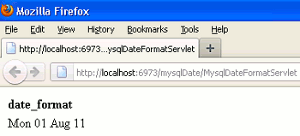
Output :
When you will execute the above example you will get the output as :
[ 0 ] Comments